

In recent weeks, a number of doomsday articles, blogs and opinions have inventively been written and published that have gone viral, so much so, that the markets were impacted. I’m not going to link to them because the paranoia, distrust and hopelessness aren’t what you need to know or focus on to prepare for AI.
Instead, first read this article from about 10 years ago where the author recalls his experience from 1997. He can’t link to the original sources or articles because not much of the 90’s internet remains. If you happen to have read the recent alarming articles, you really need to read this. The Day the World Didn’t End
In 1997, I was the Financial Controller for a start-up, dial-up internet service provider. On December 31, 1999, I recall exactly where I was, not at work with my fellow work colleagues ferociously trying to prevent an apocalyptic demise, but at a party with them as we were all conclusively sure the world was not ending that day.
The consensus is that this time is different. While it is, with many companies that existed in 1999 no longer in business including the one I was working for, those that are in business will not be making the same mistakes twice. Most companies, including the Fortune 500, are currently evaluating AI and how it will specifically fit into their organization but with a deep, slow, benefit-based approach.
First, some perspective, in that 84% of the world has never used AI. The vast majority of those who do, use a free chatbot version.
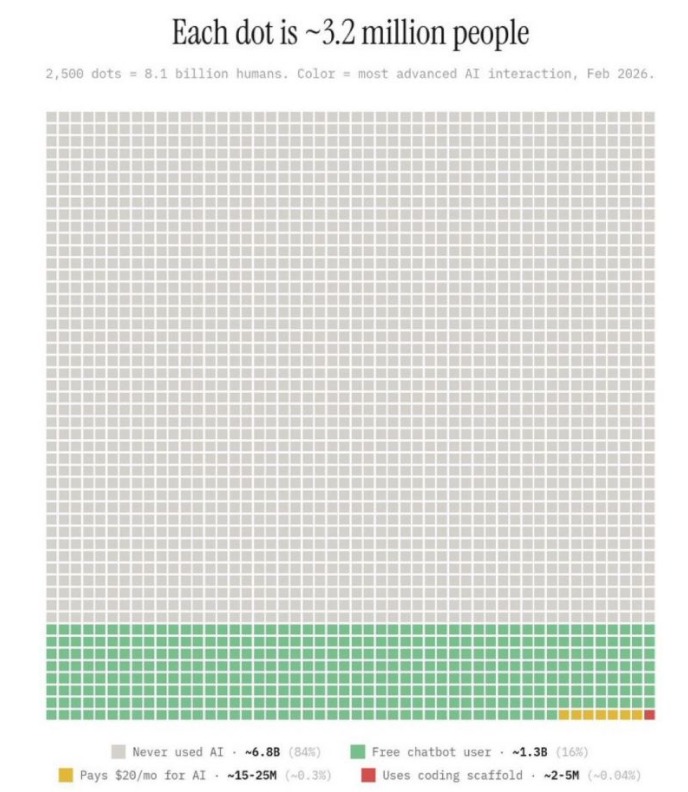
Graphic data from Microsoft’s AI Economy Institute Global AI Adoption Report (January 2026)
Of the 80% of Fortune 500 companies using AI agents built with low-code or no-code tools, they are automating tasks that support individuals and teams in sales, finance, security, customer service and product development, where knowledge management rules.
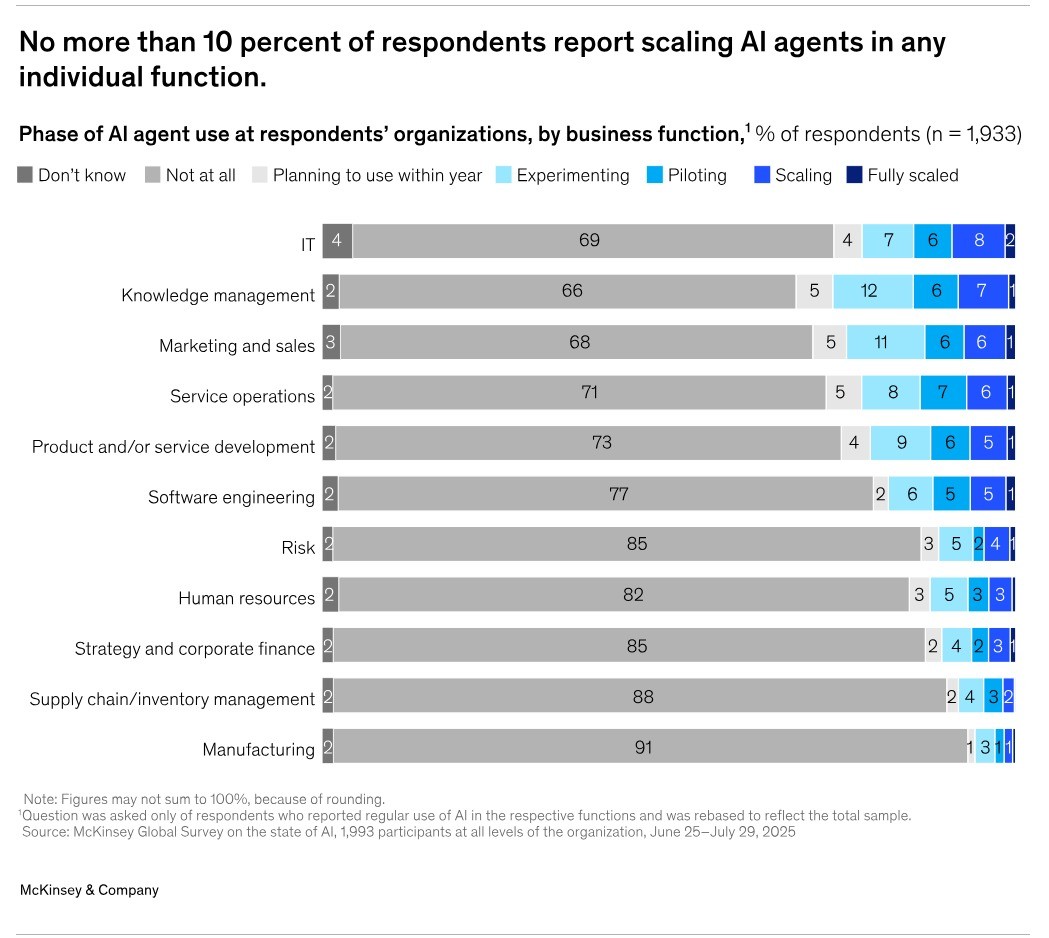
However as of November 2025, most are still in the experimentation or “piloting” phase. Nearly two-thirds of a McKinsey State of AI survey, respondents acknowledge their organizations have not yet begun scaling AI across any one function let alone their entire organization.
Despite the growing use of AI, only 47% of organizations report having adequate security controls in place. (Microsoft Data Security Index 2026). This gap suggests many companies are adopting AI tools faster than they are implementing safeguards. The report found that 29% of employees are already using unsanctioned AI agents for work tasks. This so-called “shadow AI” can operate outside the visibility of IT and security teams, increasing the likelihood of data leaks and misuse.
An Executive Advisory Board convened at the University of Wisconsin-Madison including Directors, VPs and CEOs from Google, Walmart, Intuit, Kohler, 3M, Kimberly-Clark, Hyatt and others also in November 2025. The sentiment, “AI is a business imperative but a failed project could ruin my career.”
They feel as if they are building the plane while it is in the air, flying without the instruments. Proven software decisions follow a predictable path of case studies, expert consultants and structured RFPs. AI case studies are rare, and best practices change every few months. Decisions like “buy vs. build” have become much more complicated.
Absent case studies or roadmaps, company leaders are turning to “pilots” to manage risk. These are short, 3-6 month experiments with only a small group of their employees. These teams iterate through multiple rounds of testing and use success criteria to decide what may be worth scaling. The best companies are leveraging a learning agenda that is built with a library of questions and outcomes transforming into a productive base of experience across technologies, vendors and use cases.
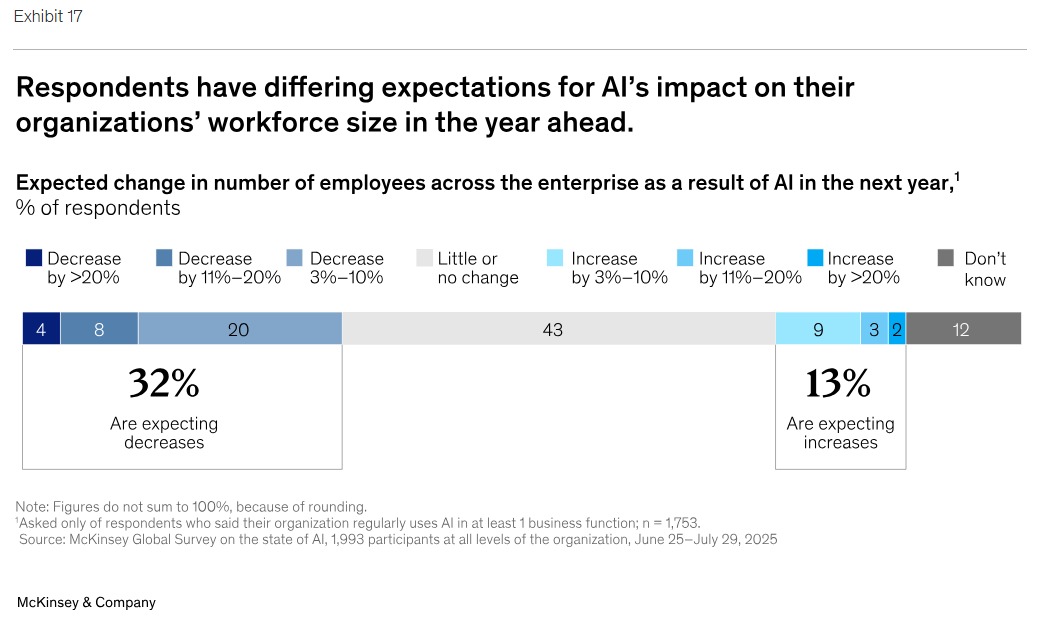
Then there is the human problem. Since most people aren’t even using AI, how do you get them to learn or even attempt it when all they know is that it could cost them their job? The reality is that 68% of companies are not expecting to decrease their workforce this year with 13% expecting to increase. Less than 1% of layoffs in the first half of 2025 were the result of AI increasing employees’ productivity (Gartner).
So, how do you future-proof your job and career against AI? I didn’t find any earth-shattering advice other than the obvious of being flexible, reliable, accountable, open-minded and creative with networking and people skills. However, the one thing I believe that will keep companies in business and set them apart in the competition is their employees’ knowledge and understanding of what their company does and how things really work. It’s not sitting in your cubicle, office, basement or café doomscrolling through data, endless analytics and reports. It’s lacing up your steel toe boots, putting on a safety vest or scrubs (gowning up), donning a hard hat, safety glasses or gloves and going out into the field, manufacturing floor, jobsite, delivery, customer meeting, whatever, to find and understand the real problems and figuring out how to solve them.
Companies who can effectively execute on solving their customer’s problems by truly knowing and understanding their company processes in serving those customers, what they want and how to deliver it to them, will prevail. Their reputation in delivering the best customer experience whether that is in their service or products precedes them with their customers and employees building that recognition and respect.
There will be failures as there always are and companies who won’t be able to compete in an AI enhanced world, eventually will fade from existence. The determinant won’t be how large or small the company is, it will be how effective the company and its employees can adapt with limited capital funds to keep their customers and win more over.
To survive and thrive in an AI-driven world, companies will need to embrace AI as a tool that enhances, not replaces, human capabilities, fostering an AI-fluent culture integrating intelligent automation where it best serves their unique processes and, ultimately, their customers.
The State of AI: Global Survey 2025 | McKinsey
Almost every company is talking about AI; only two are clearly quantifying benefits – Sherwood News
Majority of Fortune 500 firms now using AI agents, but…
Optimistically Scared: What Fortune 500 Execs Really Think About AI | Wisconsin School of Business
If you are truly curious search on Cintrini and separately, Matt Shumer.
Anecdotally, this is where the worry should lie.
Is Gen Z really bringing mom and dad to interviews? | HR Dive
Emails that I’ve gotten from parents
Featured Image – Robots at the MGM Grand, Las Vegas circa 2012, that’s 14 years ago.
Link to share: The Missing Context of AI – CacheCoach.com