
[Updated Footnote] While the S&P 500 soars to record highs, consumer sentiment barely has a pulse.
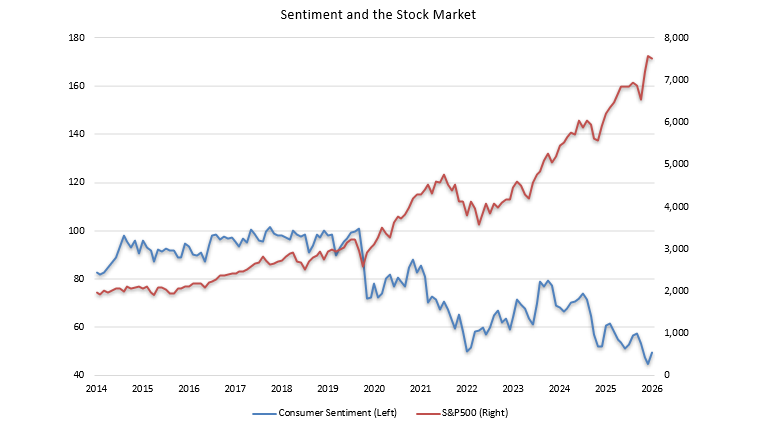
We can blame the unrelenting social media algorithms feeding our smart-phone induced herd mentality of the dire times and uncertainty. Or the nightly news capping our day with the calamitous events before they give us only a glimpse of good news at the end. Or we automatically attribute it to the polarizing political environment because of the line colors and directions.
Doom and gloom sell; it captures and holds our attention.
What if consumer sentiment and how it is measured is no longer an accurate indicator of consumer attitudes and their actual spending?
Even David Kelly, Chief Global Strategist at J.P. Morgan Asset Management questions whether consumer sentiment is still a useful contra-indicator for the stock market.
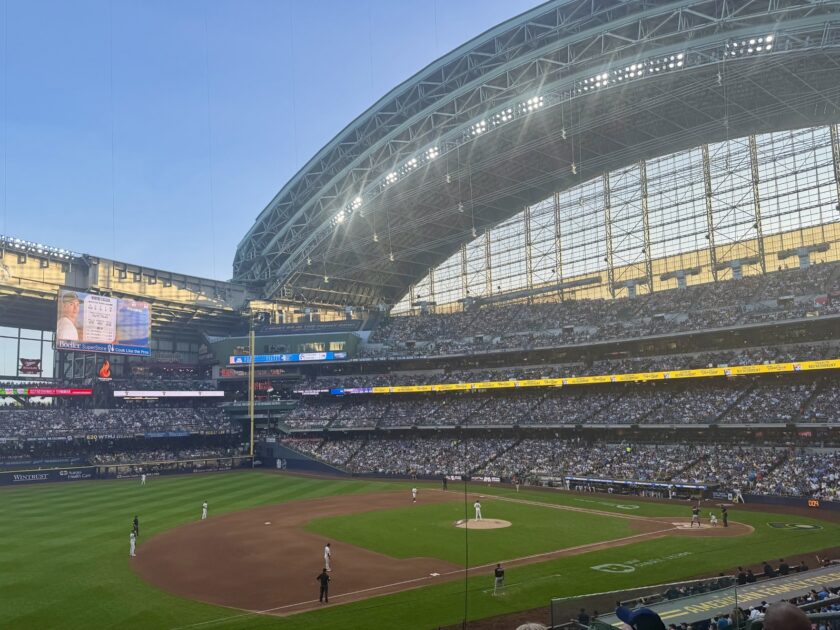
My brother was in town last week. He wanted to go to Milwaukee and see a Brewers game because they have one of the best records in MLB this year. It was a great game on a classic summer Saturday night that exceeded all of our expectations but that’s not what only stood out. The stadium was almost full despite the expensive tickets and food. It wasn’t just a guys night out. The venue was American Family Field, and it was exactly that. Parents with babies sporting noise-cancelling headphones toting toddlers in front of us, a family with teenagers on one side and a group of Gen Z on the other. It was a fun experience for all where phones no longer consumed the focus.
Maybe it was due to being one of the most Midwestern games possible since they were playing the Minnesota Twins. Then I found the MLB Attendance Report where the LA Dodgers, San Diego Padres and NY Yankees lead with year-over-year attendance that continues to grow and break records.
This had me thinking what else. June 16, 2026, was officially the highest attended day in the history of the FIFA World Cup. The total 2026 attendance shattered previous marks, the largest ever.
Maybe it’s only sports and expanded my search to prove myself wrong. Live Nation’s second quarter ending June 30, 2026, resulted in record fan growth driving the strongest concert ticket sales the company has ever seen as more artists tour than ever.
Sports and concerts, what else?
The single busiest travel day in U.S. aviation history occurred on Sunday, November 30, 2025. This record surpassed the previous peak set earlier that summer. On a global scale, July 23, 2026, was recorded as the busiest day for air traffic in human history.
And as of August 10, 2026, The Odyssey prevails as the highest grossing IMAX release of all time.
What if consumer sentiment is no longer about “things?”
The Silent generation was raised by parents who lived through the Great Depression. They learned to save everything and fix broken items attaching sentiment to those “things.” They developed a scarcity mindset because everything holds value and meaning.
The Baby Boomer generation followed World War II and also places a high value on physical possessions, viewing them as symbols of status, hard work and sentimental history. They matured during a time when physical goods, brand loyalty and home ownership defined personal success.
The pivot starts with my generation. Gen X values practical utility and financial security over the accumulation of material goods. I drop off material goods at Goodwill every month. My husband puts out large items for garbage pickup frequently. And we dread the day when we have to clean out our parents’ homes.
Millennials favor minimal possessions and prefer spending discretionary income on experiences rather than physical goods. And Gen Z predominantly values physical possessions the least, choosing instead to spend their money on travel, concerts and live events.
We are asking the wrong questions.
Just as home décor dates with time, so does consumer preferences and it’s time for an update.
We have entered the “experience economy” where even when inflation rises and spending is more deliberate, consumers in both mature and emerging markets continue to prioritize experiences. It’s the desire to create moments that matter, that are meaningful as well as memorable.
Sentiment is no longer attached to a “thing” but to an “experience” instead.
Long-term demand for experiences is growing at a higher pace (2.6%) than the growth for nonessential goods (0.8%). Goods are now a commodity. You can source something new or a replacement in a matter of minutes and have it delivered to your door in day or two. The scarcity has been eliminated. The novelty for experiences is only beginning.
The attention economy is shifting. Our attention is being captured by the significance of “being there,” to experience the element of surprise while creating enduring memories with others. The memories are treasured, not the things that connect us to those times.
And that is good news.
“In a world of endless screens and AI-generated everything, the one thing that can’t be copied is being there. More artists are on the road than ever — and fans keep choosing to be in the room with them…” -Michael Rapino, President and CEO, Live Nation
“Because songs will be all they have to remember those of us who could write.” –The Odyssey
Consumer Sentiment and the Stock Market | LinkedIn (opens in new tab)
World Cup Fever Is Real: Attendance Records Continue to Fall (opens in new tab)
Live Nation Entertainment Reports Second Quarter 2026 Results (opens in new tab)
THE ODYSSEY Sets Records For Nolan and IMAX (opens in new tab)
State of Consumer 2026: Four Key trends to watch for | McKinsey (opens in new tab)
Footnote: My husband and I attended the Iowa State Fair this year, one of the top 5 in the country. We hadn’t been since we were dating. This year, 2026, set 6 separate attendance records including total attendance previously set in 2024. The experience economy is only getting started.