
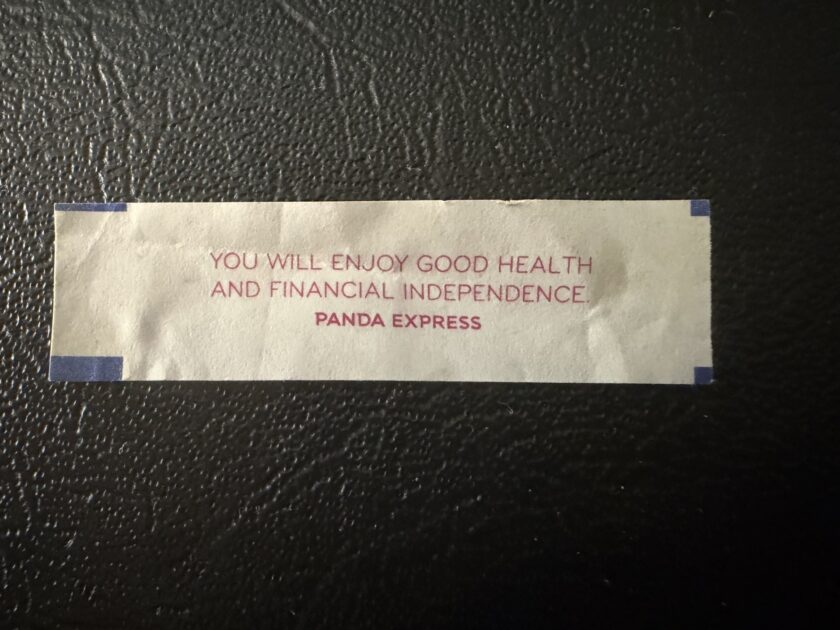
Luck is an equation. It isn’t whether you are simply lucky or unlucky and that everything happens by chance or divine intervention.
If you take the literal definition of luck as the occurrence of events that happen to a person by chance, bringing either apparent good fortune or bad fortune without being planned or earned, luck is completely out of your control.
Then why even attempt to invest if you did not train, practice or have any experience in developing the skill or understanding necessary to effectively manage stocks, bonds or investment funds?
If it is only by chance that your hard-earned money could become a fortune, why take that inordinate amount of unknown risk?
Because there is more to luck.
It is completely out of our control where, when and to whom we are born. We can’t change our genetics, family background or innate talents which serves as the baseline blueprint for our life. (Heaven Luck, Sans Chi)
We can, however, eventually change the environment we live in and the people we surround ourselves with. It’s where we choose to live, what field we work in and who we choose to marry or not. (Earth Luck, Sans Chi)
Human luck (Sans Chi) emerges from how we respond to what happens to us and is what caught my attention for Tina Seelig’s new book which I haven’t read yet. It’s how we adapt to our circumstances and the decisions we make.
In the illusion of control, I wrote about how little control we actually have but that “our lives are not determined by what happens to us, but how we react to what happens; not by what life brings to us, but the attitude we bring to life.”
According to Jim Collins, luck in its rigorous true form is an event that you didn’t cause. It comes as a surprise in some significant way with consequences, good or bad but you don’t create it. His and Morten T. Hansen’s philosophy (Great by Choice) is great leaders and companies do not get more luck than others, but instead get a higher return by making the absolute most of the good and bad luck they receive.
It’s the “return on luck.”
It’s not the cards you are dealt, it’s where and how you play the cards.
If you are idly waiting or expecting certain cards to be dealt to you, your opportunities in life may walk right past you. Having kids was never in my cards. I didn’t make my life about relentlessly pursuing that one card I didn’t have. I was, however, extremely lucky that we moved to Los Angeles in 2008 where a world-renown surgeon practiced and I no longer had to wear the hearing aids I had since my early thirties.
How can you influence your earth/human luck or the return on your luck?
The Chances We Take
We experience losses much more keenly than we experience gains. (Prospect Theory, Daniel Kahneman, Amos Tversky) It makes us inherently much more risk averse choosing the options with the lowest possible loss. However, the more opportunities we expose ourselves to or insert ourselves into, the better chance the expected gain is much higher.
Maximize your opportunities by investing in diversified funds understanding that overtime the returns will compound far greater than any gain you had expected.
Follow your intuition. You may not know a lot about investing but you do know that your workplace retirement plan (401k) and a brokerage account with a respectable firm (Vanguard, Fidelity, Schwab) and your trusted financial advisor/planner are legitimate places to invest your money. If it sounds too good to be true, it likely is.
Don’t be a permabear. Expect good fortune. Our life and rate of return aren’t determined by what life or the market brings to us but the attitude we bring to life and investing. Staying invested for the long-term with a plan even through the bad markets will bring much greater fortune than reactionary selling and then trying to rebuy all that you had at a higher basis price or not at all.
Bad luck isn’t the end. It’s how you choose to react and make the most of your circumstances.
The Choices We Make
According to Annie Duke, it’s all in the quality of decisions we make, good and bad. Bad decisions are wrought with overconfidence and winging it while good decisions are thoughtfully assessed and explicit.
Be willing to look at your mistakes from prior decisions as well as the biases and patterns you fall prey to. By writing out the possible outcomes of a future decision, you can try to forecast the results. Take a weighted average of the distribution of outcomes that could occur just like a return on investment. Factor in contingencies, cost of failure and opportunity costs.
The key, however, is making the decision process explicit rather than keeping it implicit within your subconscious. Good decision making has to be intentional and accountable and the only way to do that is to share it with others.
It is not only the big life-altering decisions that involve preparedness, critical thinking, seeing the big picture and collaboration. It takes a deliberate process to become a skilled decision maker.
The equation of luck is multisided and nonlinear that requires an open mind and paying attention to realize its full potential. It’s not only the chance, unpredictable events that occur, good or bad, and making the most of them to maximize our “return on luck” but it is also the chances we take and the choices we make to “create or influence our own luck.”
How To Create Your Own Luck – Fast Company