

This new-found strategy for diversifying your investments is not an official one. It is, however, more palatable and aesthetically pleasing than a large block of technical financial text to chew on. If it is implemented according to your tolerance level, it will eventually pay off. If it is implemented too much or not at all, the effects will likely be worse.
We think that diversification is owning 20 different stocks, several index, mutual and ETF funds, a retirement account and a brokerage account. Even more, that they are held at different brokerage firms like Fidelity, Vanguard, Charles Schwab and T. Rowe Price.
We know to not put all of our eggs in one basket because of what happened to Enron.
True diversification evens out the emotional and financial “roller coaster” we ride of the market ups and downs by combining assets in our overall portfolio that respond differently to the same economic events. It is a method for managing risk, not maximizing peak returns. When implemented correctly, diversification protects our investments during a market downturn.
To understand what real diversification is, this new approach is both timely and a treat to implement. But first, we need a baseline for different levels of diversification. I think Fidelity does a good job visually depicting this. Of course, I am biased because I use their financial model.
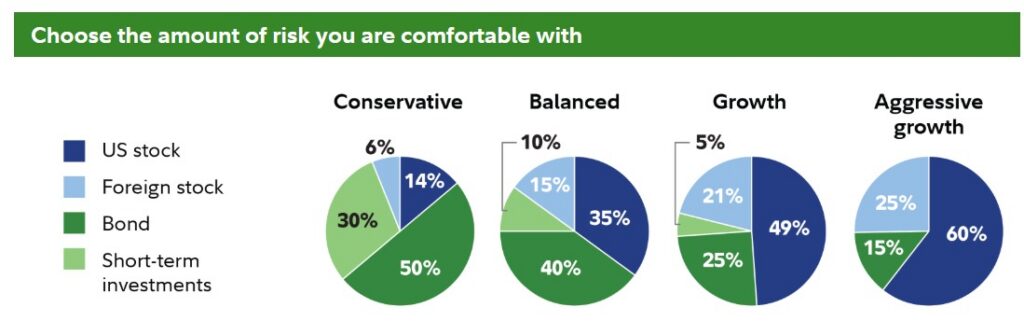
The amount of risk you are comfortable with is determined by factors personal to you. It depends on your personality and temperament, your circumstances, your age and your investment knowledge and experience. My husband and I are both even keeled and not prone to irrational decision-making. So, we were Aggressive growth+.
We didn’t even realize the extent of our risk until I loaded all of our investments (ticker symbol of the funds plus number of shares) held outside of Fidelity into the Fidelity model and found we had less than 10% in bonds. We were dead on the foreign stock allocation but that will decrease as we sell my husband’s company stock for short-term investments.
In Fidelity’s guide to diversification, they show a header picture of a variety of dried fruits and nuts. I’m going to take this one step further with this new strategy. My intent is that it will be understandable and memorable.
Imagine that your investment portfolio consists of only one or two of these asset types or sectors.
Tech Stocks (AI, semiconductors, microchips, hard/software) → Nerds Gummy Clusters
(Alphabet, Amazon, Apple, Nvidia, Microsoft, Meta, Tesla)
Blue Chip Stocks (large, established, financially stable) → Reese’s Peanut Butter Cups
(AbbVie, McDonald’s, AT&T, Walmart, ExxonMobile)
Defensive Stocks (steady earnings / dividends, lower price volatility) → Peanut M&M’s
(Johnson & Johnson, Procter Gamble, Coca-Cola, Chevron)
Bonds (traditional yet polarizing) → Peanut Butter Kisses
(Treasury / Government, Investment-Grade Corporate, High-Yield Corporate (Junk), Mortgage-Backed, Municipal, Foreign)
Cash and Cash Equivalents (bear market go-to) → Gummy Bears
(Currency, U.S. Treasuries, Money Market Funds, High Yield Savings, CD’s)
Alternative Investments
Real Estate → Baby Ruth and the Sour Patch Kids
Commodities (wheat, corn, gas, electric, gold, crypto) → Jolly Rancher and the 100 Grand
Private Equity → Mounds
(the cash / coconut divide)
Private Credit → Circus Peanuts
(unsure what you are biting into)
Industries & Sectors
Cyclical Sectors (retail or travel) → Skittles
Defensive sectors (consumer staples, utilities or healthcare) → M&M’s
Foreign or International Markets (developed and emerging economies) → Swedish Fish, Haribo Goldbears and Nestle Crunch
Company Size
Large-cap ($10+ Billion) → Hershey’s Bar
Mid-cap ($2 – $10 Billion) → Junior Mints
Small-cap ($250 Million – $2 Billion) → Dots
Diversification, just like Halloween candy, is achieved by mixing fundamentally different types of investments (candy) because they react uniquely to inflation, interest rates and recessions.
The true magic of diversification is having assets in your portfolio that do not move in tandem. When one asset drops, another tends to hold steady or rise which will soften the roller coaster ride.
There are diminishing returns of simply adding more stocks. Research shows that holding roughly 25 to 30 well-chosen, non-correlated stocks or using broad Exchange-Traded Funds (ETFs) captures most of the company-specific risk-reduction benefits.
Diversification can’t eliminate market or systematic risk such as a massive global recession. If the entire stock market plunges, almost all equities will feel the drop together. It also does not guarantee a profit or prevent all losses. It only limits the damage of isolated events and reduces volatility over a long-time horizon.
You will probably never look at Halloween candy in the same way again.
However, it may serve as that annual reminder to rebalance your portfolio if needed and that some candy has more upside than others.
Is It Time to Rebalance Your Portfolio? – A Wealth of Common Sense
Guide to diversification | Fidelity
Featured Image – house at front of subdivision including colored fog and Halloween rendition of “I love Rock ‘n’ Roll Halloween” at night.