

One night a few weeks ago, I was driving to meet my husband for an event. I left at precisely the right time to watch an amazing sunset as I drove west. The hues of orange and blue reflecting on the high clouds were brilliant. I extended my drive as long as I could but had left later than I wanted to.
When we try to time something like a sunset or sunrise, it inevitably turns out less satisfying than what we anticipated it to be. We build up our expectations awaiting the spectacular view only to be disappointed when all we see is the monotony of the blue sky fading into or from the darkness.
A spectacular sunset or sunrise requires a combination of factors including mid-to-high level clouds to scatter light, clean and dry air with specific particle content and a clear view of the sky and horizon. The optimal combination of factors is difficult to predict.
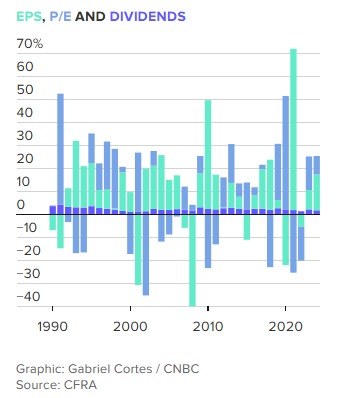
The price of stock is also difficult to predict and driven by a combination of factors. There are three long-term fundamental building blocks to the price of stock contributing to its growth.
1. EPS (Earning Per Share) – how much earnings or profit the company can generate.
2. P/E (Price-to-Earnings Ratio) – the proportion of a company’s share price to its earnings per share. A high P/E ratio could indicate that investors expect high growth rates or the company’s stock is overvalued.
3. Dividends – a company may distribute some of its profits back to shareholders in the form of a cash payout known as a dividend. Some stocks are aptly termed dividend stocks.
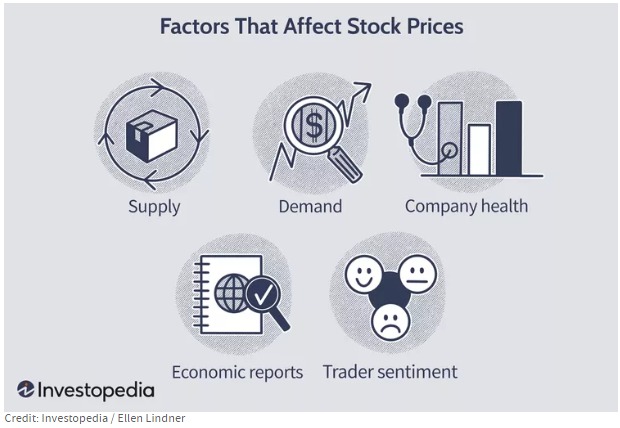
There are also a number of short-term factors that can affect the price of a stock. As we experienced in 2020, supply and demand. More recently, reports on the economy including political and the overall strength of the market sector the company trades within.
Market or trader sentiment is the component of the stock price that is the most vexing. It represents the psychology of market participants, individually and collectively and is often subjective, biased and obstinate.
Liquidity and other underestimated factors like trends, demographics and incidental transactions can affect the price of the stock but more often in the short-term.
While the most avid investors are closely following these factors for the stocks they own and any potential upside to an emerging company or trend, most of us are too busy with life and other interests to pay this amount of our fleeting attention to this one subject. The opportunity cost is too great.
So, we invest in funds. It increases our likelihood of experiencing greater returns without having to track and manage each stock individually which is time consuming. Some of us have a brokerage account like Webull or Robinhood where stock trading has become much more accessible. However, I can’t tell you the last time I considered spending my time doing that. Maybe it will become a hobby later in life but for now, the need for net worth building prevails.
I increase the likelihood of experiencing a spectacular sunrise, which we have many of this time of year, by getting up well before sunrise. In a sense, it increases my luck by creating more chances or opportunities to see them because I never know which morning those contributing factors are all present.
When we try to time something like the price of stocks in the market, it inevitably turns out less satisfying than what we anticipated it to be. We build up our expectations awaiting the spectacular returns only to be disappointed when all we see is the monotony of the market fluctuations.
“The economy is the value that we create. Stocks are an expression of that value, but they trade on the present reality times a multiple of future expectations.” –Callie Cox
Stock Prices: 6 Things That Move Them Higher And Lower | Bankrate
Factors That Move Stock Prices Up and Down
3 drivers of stock market growth: Understanding can help you invest